

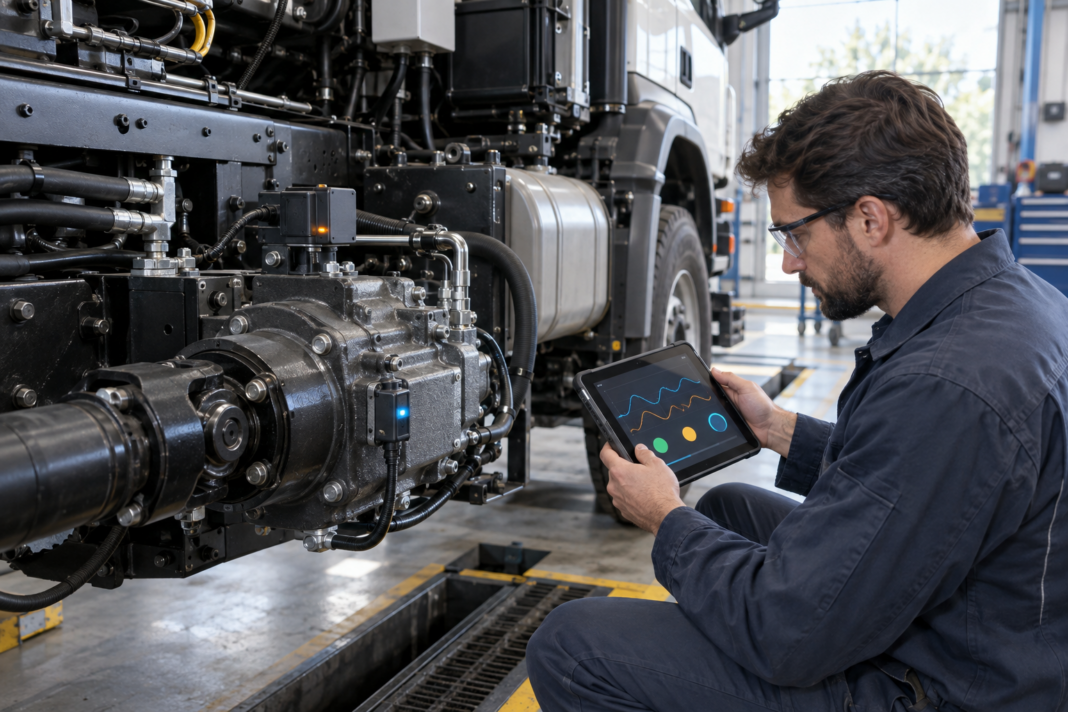

A traditional PTO already gives a vehicle the ability to power auxiliary equipment such as hydraulic lifts, pumps, compressors, firefighting systems and service bodies, and industry references such as Geotab describe PTOs as mechanisms that transfer vehicle power to auxiliary tools, while newer fleet telematics approaches make it possible to monitor PTO engagement, operating time and possible misuse through vehicle data. In practical language, this means the PTO is moving from being a silent mechanical servant into a visible performance signal inside the fleet management system, and for manufacturers such as Özcihan Makina, this future creates exciting opportunities to combine durable mechanical engineering with smarter integration expectations.
From Power Transfer to Power Intelligence
For many years, the main question around what is a pto? was simple: can this unit transfer enough power for the job, fit the vehicle transmission, support the hydraulic pump and survive demanding field conditions? Those questions still matter deeply, because no amount of digital intelligence can compensate for weak mechanical foundations, yet the new question is becoming more layered: can the PTO communicate its status, support predictive maintenance, reduce idle waste, integrate with electric powertrains, protect the operator and help the fleet owner make better decisions based on real usage data? I find this shift very meaningful, because it turns the PTO into something closer to a nervous system node inside the vehicle, where power, data and safety flow together rather than separately.

The future will not replace every mechanical PTO with a fully electric system overnight, and I honestly think that would be an unrealistic way to view the industry, because construction trucks, municipal vehicles, agricultural support trucks, firefighting fleets and industrial service vehicles all have different duty cycles, budgets, operating cultures and maintenance realities. Instead, the future will likely be mixed and practical, with conventional truck pto models, advanced hydraulic integrations, smart sensors, CAN based communication, connected telematics, electric PTO interfaces and high voltage ePTO systems living together in the same market for many years.
Why Connected PTO Systems Matter
Connected PTO technology matters because a fleet manager cannot improve what they cannot see, and PTO related work has often been hidden behind engine hours, driver notes, workshop experience and occasional failure symptoms. With connected systems, the fleet can see when the PTO was engaged, how long it stayed active, whether the vehicle was stationary or moving, whether the operator used the system outside recommended conditions, and whether unusual patterns suggest excessive wear, poor training or a mismatched application. Geotab explains that telematics devices can gather information from the vehicle control system and provide data on PTO status, which is especially useful because many PTO applications should be monitored carefully for safe and efficient use.

In real life, this is not just a fancy dashboard feature; it can become a daily operational advantage. Imagine a municipal waste truck that runs hydraulic equipment for hours every day, a road maintenance vehicle that uses spreading equipment during winter operations, or a fire service vehicle that depends on pump readiness when seconds matter, and then imagine the fleet manager being able to compare PTO operation across vehicles, notice abnormal operating times, plan service before a failure and train operators with real evidence instead of guesswork. That is why smart PTO technology feels less like a luxury and more like a natural next step in professional fleet management 🚚.
Smart PTO Compared with Traditional PTO
| Feature | Traditional PTO Mindset | Smart and Connected PTO Mindset | Practical Benefit |
|---|---|---|---|
| Operation visibility | Mostly checked by operator feedback and manual inspection | PTO engagement and usage data can be monitored through telematics | Better fleet control and fewer unknowns |
| Maintenance planning | Service intervals often depend on general mileage or fixed schedules | Maintenance can consider actual PTO usage hours and working patterns | More accurate service timing |
| Safety support | Relies heavily on training and operator discipline | Alerts and interlocks can help reduce incorrect usage | Lower risk during auxiliary equipment operation |
| Energy management | Engine driven power is common and may involve idle time | Electric PTO and hybrid integration can reduce idle based operation | Less noise, lower emissions and improved efficiency |
| Body builder integration | Mechanical matching is the main focus | Mechanical, hydraulic, electrical and communication interfaces are planned together | Smoother vehicle equipment integration |
The most important point in this comparison is that smart PTO does not make mechanical design less important; it actually makes good mechanical design more visible, because data quickly shows whether a system works comfortably or struggles under real load. When a PTO, hydraulic pump, shaft, valve and control system match the application properly, the data tells a clean story, and when they do not match, the data becomes a warning light before the problem becomes an expensive roadside event.

The Role of ePTO in the Connected Future
Electric PTO, often called ePTO, is one of the most important parts of this future because electric and hybrid commercial vehicles need a way to power auxiliary systems without depending on a conventional engine driven PTO. ACEA describes electric power take off as a technology that lets vehicles use electrical energy from their powertrains for auxiliary functions, and SAE’s J3253 electric PTO interface standard covers connection systems, body builder communication modes and suggested operational modes for commercial vehicles, which shows that the industry is not only inventing new components but also building common communication rules around them.
-212781031195243.png)
Parker’s high voltage ePTO H075 system is a good example of where the market is heading, because its published data describes a ready to install hydraulic power system for battery electric and hybrid electric commercial vehicles, with 75 kW peak hydraulic power, more than 80 percent energy transfer efficiency, software selectable hydraulic control modes and components such as an electric motor, inverter, machine controller, cooling system and flexible pump interface. I like this example because it makes the future feel tangible rather than abstract, since it shows how an ePTO can become a packaged power unit that supports refuse haulers, dump trucks, utility fleets and aerial lift vehicles while reducing engine idle, noise and local emissions.
This does not mean every vehicle will immediately move to ePTO, but it does mean future planning should include electric readiness, especially for fleets that operate in cities, low emission zones, indoor or semi indoor environments, night operations, public service routes and noise sensitive areas. In that future, companies that understand traditional PTO durability and complementary components, including hydraulic pump models, gear pump models and piston pump models, will remain highly relevant because electric power still needs practical hydraulic execution.

Communication Between Vehicle and Body Equipment
The smartest PTO future will depend on communication between the truck chassis and the installed body equipment, because a PTO does not work alone in modern vehicles; it works with engine control units, transmission logic, hydraulic pumps, safety switches, operator panels, body controllers, sensors, telematics devices and sometimes battery management systems. In simple terms, the body equipment needs to tell the vehicle what it wants, the vehicle needs to confirm what it can safely provide, and the PTO system needs to deliver power in a way that respects torque limits, energy limits, speed requirements and safety logic.

This is where standards and digital interfaces become more valuable, especially for body builders who need repeatable integration across many vehicle platforms. A smart system can support modes such as stationary operation, mobile operation, remote equipment operation, load sensitive hydraulic behavior and controlled engagement, while also helping reduce wiring confusion and application mistakes. For example, a vehicle equipped with split shaft power take-off models may still rely on rugged mechanical power transfer, but the future control environment around that equipment can become more connected, more measurable and more protective.
Key Components Around the Smart PTO
A smart PTO system is never just a PTO, just as a strong orchestra is never only the conductor 🎼. The system also needs pumps, shafts, reducers, valves, couplings, wiring, controllers, cooling, sensors and correct installation, and each part shapes the final performance. For this reason, I pay attention to supporting product families such as reducer models, valves models and cardan shafts models, because smart control cannot deliver a good result unless the physical power path is also stable, correctly sized and application ready.

For emergency and municipal applications, the same logic becomes even more important, because connected power is only useful when the equipment responds reliably in the field. A fire truck using fire fighting water pump models needs more than a dashboard signal; it needs dependable pressure, correct pump matching, safe engagement and a power path that holds up under urgent operating conditions. This is why I see Özcihan Makina as part of a broader future where proven heavy duty manufacturing and smart vehicle integration gradually meet each other, step by step, without forgetting the realities of workshops, body builders and fleet maintenance teams.
The Connected Utility Truck
Let me make this more concrete with a simple example, because I always find that technology becomes easier to understand when we place it on a real vehicle instead of leaving it in a brochure. Imagine a connected utility truck that operates a hydraulic aerial lift during city maintenance work, and throughout the day the PTO system records engagement hours, the telematics platform compares idle time with productive work time, the body controller manages safe operating modes, the hydraulic pump responds according to load demand, and the maintenance team receives early signals if operating patterns move outside normal behavior. In this case, the PTO is not just a mechanical output anymore; it is part of a digital work record, a safety process and an energy management strategy, which is why smart connected systems can create value far beyond the component itself.

I once compared a poorly monitored PTO fleet to a restaurant kitchen where nobody writes down orders, nobody checks the stove temperature and everybody only notices a problem when smoke appears, and that little metaphor still feels accurate to me because many failures begin as small signals long before they become dramatic problems. Smart PTO technology gives fleets a way to notice those small signals earlier, and it gives operators a clearer relationship with the equipment they use every day, almost like turning a silent machine into a teammate that can finally explain what it needs.
What Fleet Owners Should Prepare For
Fleet owners and body builders should prepare for a future where PTO selection includes both mechanical and digital questions, because the right unit will need to match torque, rotation, duty cycle and pump demand while also fitting the vehicle communication environment, data needs, safety logic and energy strategy. They should ask whether the vehicle needs stationary or mobile PTO operation, whether PTO engagement data should flow into a telematics platform, whether electric readiness matters for upcoming city regulations, whether hydraulic components are sized for actual duty cycles, and whether service teams can interpret both mechanical symptoms and digital alerts.

The best approach is not to chase technology for the sake of technology, because a connected feature that nobody uses is like a beautiful toolbox that stays locked in the corner. The better approach is to define the job first, understand the vehicle’s working day, select the PTO and hydraulic components around that reality, and then add smart monitoring where it creates measurable value. This is where Özcihan Makina can support the conversation through application oriented product thinking, because real fleet performance depends on choosing components that make sense in the dirt, dust, pressure, vibration and time limits of daily work.
The PTO Becomes a Smart Power Partner
The future of PTO technology will be smart, connected and more deeply integrated with vehicle architecture, but it will still need the same old virtues that made PTO systems valuable in the first place: strength, reliability, correct application matching and serviceable design. The difference is that tomorrow’s PTO will not only transfer power; it will also provide information, support safer operating decisions, help reduce unnecessary idle time, integrate with electric and hybrid vehicles, and become part of a larger connected fleet ecosystem. That is a beautiful evolution in my eyes, because it keeps the hardworking soul of the PTO while giving it a smarter voice 😊.

As commercial vehicles continue to electrify, digitize and specialize, the strongest PTO solutions will come from the meeting point between mechanical durability and connected intelligence, and this meeting point will matter for dump trucks, fire trucks, refuse vehicles, utility fleets, road maintenance vehicles and many other work machines that quietly keep daily life moving. In that future, Özcihan Makina stands as a meaningful name for fleets and body builders that value practical power transmission experience, while the wider industry moves toward PTO systems that are not only strong enough to work, but smart enough to explain, protect and optimize the work they do.
